

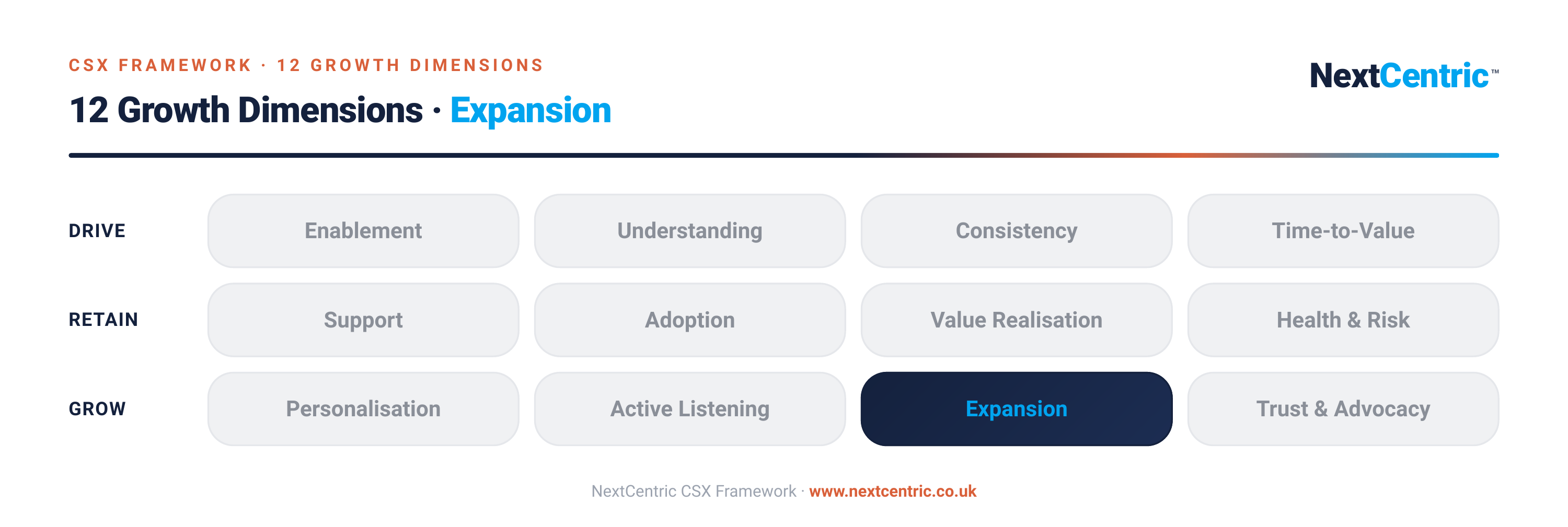
Expansion revenue is one of the cheapest forms of growth available to any business with an existing customer base, and one of the most inconsistently captured, because it has historically depended on an account owner noticing a usage pattern, remembering to raise it, and timing the conversation well. The Expansion dimension measures how systematically that opportunity is actually identified and pursued, rather than left to individual initiative.
The Key KPI is product footprint, how much of the available product surface a customer has activated beyond their original purchase, tracked as a leading indicator, because footprint growth typically precedes revenue growth rather than following it. The level path runs from no footprint tracking at all, to footprint growth that happens but goes unattributed, to systematic tracking against a target, to forecasted and proactively managed expansion, and finally to expansion that happens as a natural, customer-initiated byproduct of demonstrated value.
Where AI changes the equation
Usage-pattern analysis that predicts expansion readiness is a genuinely strong fit for machine learning, the kind of pattern recognition across large accounts and usage histories that’s slow and error-prone for a human to do consistently across an entire book of business. AI can now surface which accounts are showing the footprint signals that historically preceded an upsell, and automate the first step of the expansion playbook, flagging the opportunity and drafting the outreach, before a human ever has to notice the pattern themselves.
The metric that proves this is working is upsell/cross-sell conversion rate on AI-flagged opportunities compared to the historical baseline. If conversion doesn’t improve, the model is probably surfacing noise rather than genuine signal, and it’s worth revisiting before scaling the automation further.
The growth case
Net revenue retention above 100% is the clearest single signal of a healthy, growing customer base, and expansion is usually the fastest lever to move it. Systematizing expansion detection with AI, rather than leaving it to whichever account owner happens to notice, is one of the more direct ways to turn existing customer usage data into predictable, forecastable revenue rather than opportunistic, occasional wins.
Expansion is the direct-route-to-growth dimension in the NextCentric Customer-led Maturity Assessment, evaluated most successfully on product footprint growth and tied directly to net revenue retention. The CSX Framework links this dimension explicitly back to NRR, so the business case for AI-driven expansion tracking is built in from the start.
You can take the free maturity assessment here


Leave a Reply