

Every executive team is running the same experiment right now: hand frontline and customer-facing teams AI copilots and see what happens to productivity, cost-to-serve, and experience quality. The results are wildly inconsistent, and the reason has almost nothing to do with the AI.
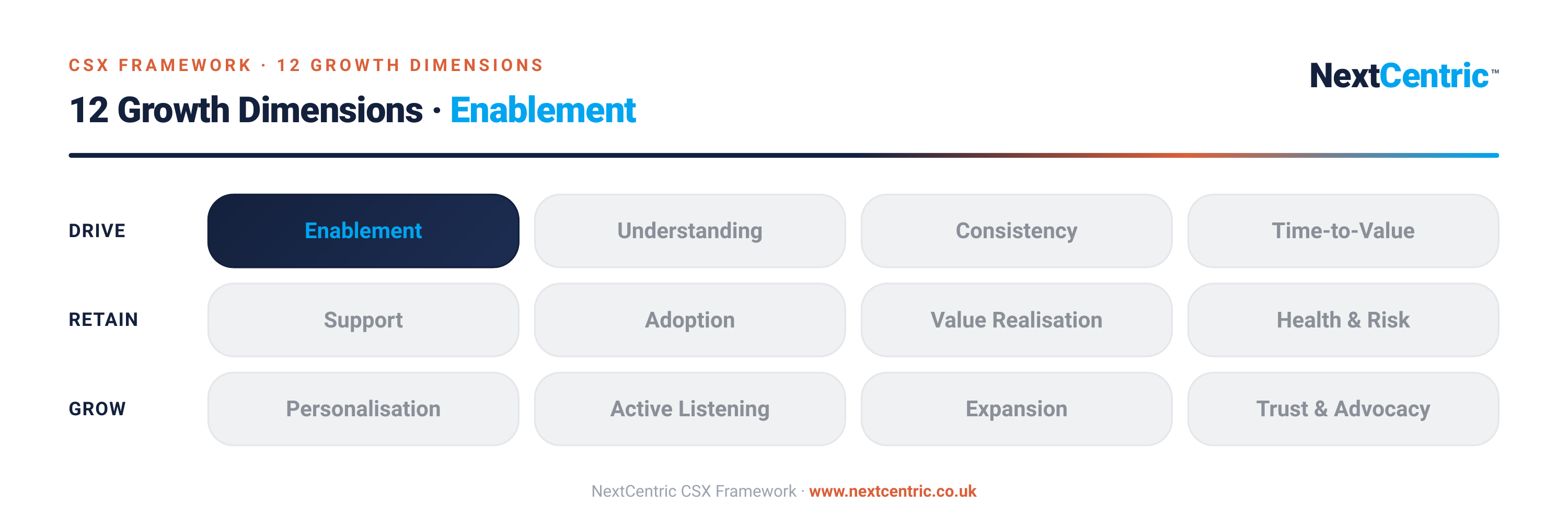
It comes down to a question that predates generative AI by decades: are your employees actually equipped to deliver a great experience? Not “have they logged into a course,” but do they have defined learning outcomes, consistent completion, coaching, and, critically, the authority to act on what they know. That’s Employee Enablement, and in the NextCentric customer-led maturity model it’s the single most heavily weighted dimension in the entire Experience group. Everything else (consistency, resolution, personalisation) sits on top of it.
Here’s why that weighting matters more, not less, now that AI is everywhere. AI doesn’t fix an enablement gap; it amplifies it. A rep who doesn’t know the product, the policy, or where their decision-making authority ends will use a genAI assistant to sound confident while being wrong faster, at higher volume, in front of more customers simultaneously. Before AI, an under-trained team was slow and inconsistent: a contained, if costly, problem. With AI in the loop, the same gap becomes a brand-risk multiplier: hallucinated answers delivered with total fluency, at scale, before anyone catches it.
The inverse is just as true. Organisations where enablement is genuinely embedded, where CX skills are coached, measured, and tied to incentives rather than delivered as a one-time course, are the ones getting real leverage from AI copilots. The AI accelerates people who already know what “good” looks like. It does not create that judgment from nothing.
What this actually costs you
Frontline attrition, escalation rates, and, most tellingly, engagement scores all trace back to enablement maturity. Employees without training, clarity, or authority don’t stay, and the ones who do resolve fewer issues without escalating. Provision sufficient enablement and track training completion rate as your baseline signal: not because it proves excellence, but because if you can’t show consistent completion, nothing built on top of it, including your AI investment, has a foundation to stand on.
The five-level path here is worth internalising at the executive level, because it’s a good proxy for how ready your organization is for AI-augmented frontline work: no training and no incentive tied to CX; some training that isn’t reinforced; trained with clear guidelines and real authority; coached, measured, and incentivised; and finally, CX excellence embedded in culture rather than run as a program. Most companies deploying AI copilots today are operating in an adolescent space whilst expecting seasoned results.
The growth case
Retention, expansion revenue, and cost-to-serve are all downstream of how consistently your frontline performs, and experience delivery is a people problem before it’s a technology problem. If you’re budgeting for AI tooling this year without first knowing where Employee Enablement sits on a 1-5 scale, you’re optimising the wrong variable.
This is exactly what the Enablement dimension measures in the NextCentric Customer-led Maturity Assessment, scored 1 (Reactive) to 5 (Optimized), anchored to training completion and evidenced with real data rather than assumption. Once you know where you stand, the CSX Methodology turns that score into a resourced plan: a defined scope, a project charter, a target operating model across people, process, and technology, and an ROI plan to close the gap.
You can take the free maturity assessment here


Leave a Reply