

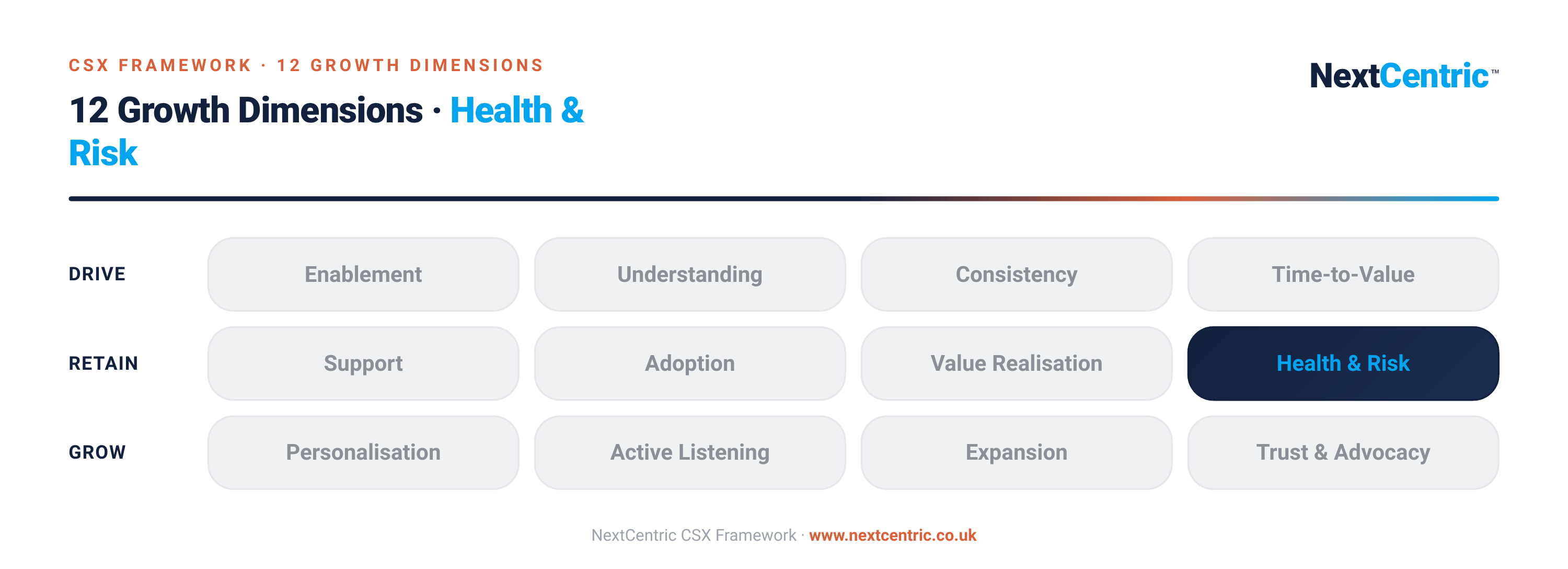
Of every dimension in the maturity model, Health & Risk is where AI and machine learning have been quietly doing real, load-bearing work the longest, well before generative AI made headlines. Predictive health scoring is one of the most mature applied-AI use cases in customer success, and it’s also one of the clearest places where maturity level directly determines whether churn feels predictable or feels like it keeps ambushing the business.
The Key KPI is percentage of an at-risk account’s lifecycle spent in an escalated state before resolution, a measure of whether risk gets caught and resolved quickly or left to linger. The level path is unusually stark: churn risk discovered only when the customer cancels, some signals noticed but untracked, a defined health score reviewed regularly, health scoring that reliably predicts risk and triggers intervention, and finally, risk caught so early via leading indicators that the customer often never feels at risk at all.
What’s new
Structured health scores, usage, support volume, contract data, have existed for years. What generative AI adds is the ability to fold in unstructured signals that were previously too labor-intensive to systematically analyze: sentiment buried in support tickets, tone shifts in sales notes, patterns across call transcripts. That combination is what pushes organisations from Level 3 (a defined score, reviewed regularly) toward Level 4 and 5, scoring that actually predicts and triggers proactive intervention before the customer complains.
The number that separates a truly proactive organization from a well-intentioned mid-range maturity one is health score predictive accuracy, its actual correlation with subsequent churn. A sophisticated-looking score that doesn’t predict anything is a dashboard, not a maturity gain.
The growth case
Every point of avoidable churn is a direct hit to gross and net revenue retention, and the earlier risk is caught, the cheaper and more effective the intervention. This dimension is where AI investment has the most directly provable, most immediate financial return of anywhere in the model, assuming the score is actually validated against real outcomes rather than assumed to work.
Health & Risk is a key predictor and proactive enabler in the NextCentric Customer-led Maturity Assessment. A high score here backed only by Gut-feel evidence is flagged automatically as a Confidence Gap, worth knowing before you scale an AI-driven intervention program on top of an unvalidated model. The CSX Methodology’s Target Operating Model stage is where that validation gets built in.
You can take the free maturity assessment here


Leave a Reply