

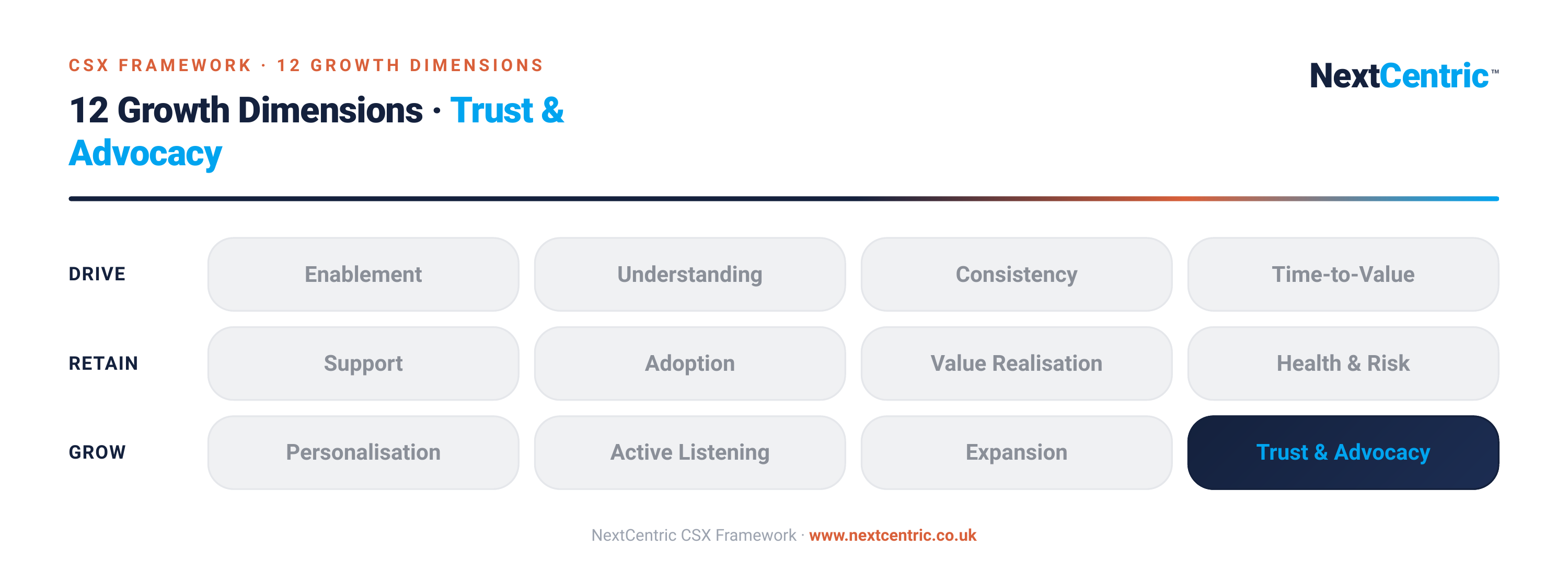
Trust and advocacy are the compounding payoff of everything else in this model done well, and they’re also, deliberately, the lowest-weighted dimension in the entire framework. That’s not because they don’t matter, it’s because they’re a lagging outcome. You don’t build advocacy directly. You build it by getting enablement, understanding, resolution, time-to-value, and value realization right, and advocacy shows up as the byproduct.
The dimension measures tangible advocacy behaviour, references given, case studies participated in, referrals made, alongside NPS and engagement signals, specifically because favourable sentiment that never converts into action isn’t the same thing as trust that actually compounds into lower-cost growth. The level path moves from no advocacy activity tracked at all, to occasional and uncultivated activity, to monitored and factored into decisions, to a deliberately cultivated program, and finally to a measurable engine of low-cost, high-trust growth.
Where AI helps, and where it backfires
AI is genuinely useful at the identification layer here: surfacing which customers, based on usage, sentiment, and engagement signals, are actually advocacy-ready, and automating the operational mechanics of a reference or case-study program, outreach scheduling, content drafting, tracking. That’s a real, low-risk efficiency gain.
Where it backfires is when AI is used to generate the actual outreach or content at the customer-facing layer without enough human judgment. Advocacy is fundamentally about trust, and trust is unusually sensitive to feeling manufactured. A referral ask or testimonial request that reads as obviously AI-generated can undo more goodwill than it captures. This is one dimension where the AI should be doing the finding and the logistics, and a human should still be doing the asking.
The growth case
Reference rate, referral rate, and review volume all feed directly into lower acquisition cost: advocacy is, quite literally, the cheapest growth channel available once the rest of the experience is working. But because it’s the most trust-sensitive dimension in the model, it’s also the one where over-automating the wrong layer does the most damage. Use AI to find your advocates faster. Keep the ask human.
Trust & Advocacy is the pinnacle dimension scored in the NextCentric Customer-led Maturity Assessment, a lagging indicator of maturity across all eleven dimensions before it. If this score is low, the fix usually isn’t a referral program; it’s further up the model. The CSX Methodology is built to work dimension by dimension, in the sequence that actually moves this score.
You can take the free maturity assessment here


Leave a Reply